Memory and loss
Never Let Me GoMemory and loss are inseparable in Kathy H.’s narration: remembering keeps Hailsham, Ruth, and Tommy present after the relationships and place themselves have vanished, but it also makes their absence impossible to ignore. As Kathy approaches the end of her work as a carer, she turns deliberately to the past, arranging memories that had once seemed separate and discovering how the school years shaped what came later. Her recollections do not reverse loss; they give it a form she can carry.
Recollection and the shape of the past
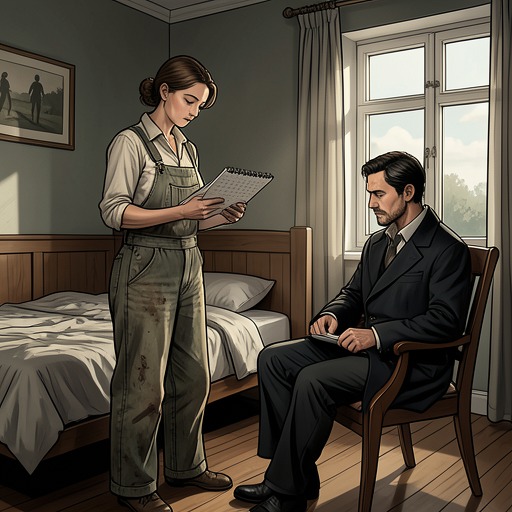
Kathy explains her return to earlier memories as part of preparing for a change in pace. At the end of the year she will no longer be a carer, and she expects to welcome the chance to rest, think, and remember. She had intended to set down what happened between herself, Ruth, and Tommy after they left Hailsham, but recognizes that later events grew out of their childhood there. The act of looking back therefore changes the scale of the story: what once seemed like children’s curiosity about Madame becomes, in retrospect, the beginning of a process that would eventually dominate their lives.
The recollections also arrive belatedly. Years after the original curiosity about Madame had become an uncommon subject among students, Tommy tells Kathy about an unusual conversation with Miss Lucy beside the pond. Only after leaving Tommy and hurrying to catch up with her friends does Kathy understand what the story has brought back to mind. Memory here is not a complete record summoned on demand. A later encounter gives an earlier experience new significance, and the meaning emerges after the conversation that prompted it.
Objects that preserve and unsettle memory
The lost Songs After Dark cassette gives memory a material form. Kathy still owns a copy and describes it as one of her most precious possessions, though the copy is not the cassette she lost at Hailsham. It is the one she and Tommy found in Norfolk years later. The present-day object thus joins two periods of her life: the original loss in childhood and the later recovery shared with Tommy. Kathy says that she sometimes listened to the tape while driving through open country, but a faulty car cassette player has made that difficult, and her busy life leaves little time to play it at home. Its importance persists even when it cannot be used as before.
The school's disappearance likewise turns memory toward ordinary images and objects. After Roger tells Kathy that Hailsham is closing, she lies awake picturing a man holding balloons, their strings twisted together in his fist. She imagines someone cutting the strings where they meet: the balloons would no longer belong together. The image gives shape to her unease that Hailsham is no longer continuing as it always had, with figures such as Miss Geraldine leading Juniors around the North Playing Field. What may make little practical difference to the students still unsettles Kathy because the school had held their shared past together.
Hailsham’s absence and the return of shared life
The news of Hailsham’s closure alters Kathy’s sense of time. In the months afterward, she realizes that things she had assumed she could do later might soon have to be done or abandoned forever. She does not describe this as panic; rather, the school's disappearance rearranges what feels urgent. When Laura suggests that Kathy become Ruth’s carer, the suggestion has an impact because it seems to draw back a veil from a decision Kathy may already have begun to make.
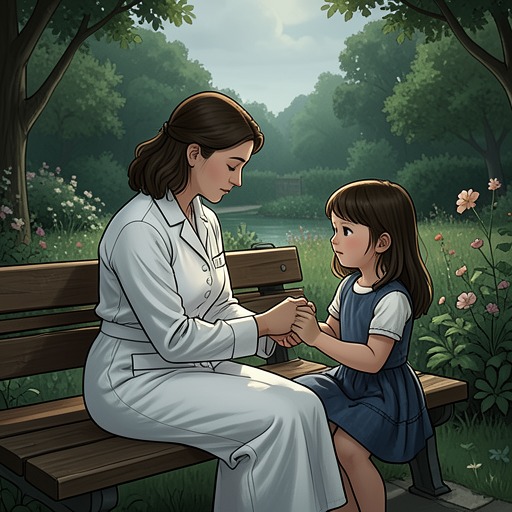
Kathy visits Ruth at the Dover recovery centre a few weeks later, about two months after Ruth’s first donation, which had gone badly. Their first meeting is encouraging: Ruth smiles, rises to hug Kathy before sitting again, and compliments her hair. For roughly half an hour they are genuinely glad to be together, talking about Hailsham, the Cottages, and their lives since then. After a later trip together, the guardedness and suspicion between them fall away. Kathy remembers the following period with gratitude: as Ruth’s health remains on an even keel, Kathy brings biscuits and mineral water in the evenings, and the two sit by Ruth’s window watching the sun set over the roofs while talking about their past and whatever else comes to mind. Ruth’s death makes the period painful in retrospect, but the renewed companionship is itself something Kathy is glad to have had.
Hailsham remains present even though Kathy does not seek out the place where it stood. She has heard stories of former students trying to find it and rumors that it has become a hotel, a school, or a ruin. While driving, she sometimes mistakes a distant sports pavilion for the school or briefly imagines that a line of poplars and an oak marks the approach to the South Playing Field. On one grey morning in Gloucestershire, she even thinks a stranded girl might be Susanna C., a former student and Sales monitor. These sudden recognitions suggest that Kathy’s refusal to search does not mean Hailsham has ceased to occupy her thoughts: its remembered landscape can surface unexpectedly in the world around her.
Ruth, Tommy, and the boundary between memories
After Ruth has completed, Kathy reflects on what she and Tommy learned too late for Ruth to know. Tommy had thought it may have been best that Ruth did not discover everything, because she had always wanted to believe in things, unlike him and Kathy, who had tried to find things out. He also insisted that what they later learned did not alter Ruth’s wish to do the best for them. Kathy has no anger left toward Ruth and accepts that Ruth had wanted the best for them at the end. Still, she wishes Ruth had known the whole truth—not simply to make her feel the damage she had caused, but because Kathy grieves that Ruth finished apart from her and Tommy, on the other side of a line separating their knowledge. She imagines Ruth would have felt that sadness too.
Kathy’s most valued memories resist the fading another donor has complained about. She has lost Ruth and then Tommy, but she does not believe she will lose her memories of them. She also accepts that she has lost Hailsham, while distinguishing the vanished place from what it has preserved in her mind. By the end of the year she expects not to be driving around as she does now; wherever she is sent afterward, she will have Hailsham with her, safely in her head. Memory offers continuity, but it cannot give the lost people access to the understanding Kathy and Tommy gained after Ruth had completed. Its comfort and its limit coexist.
Norfolk and the imagined recovery of loss
A couple of weeks after hearing that Tommy had completed, Kathy makes an unnecessary drive to Norfolk. She does not go as far as the coast and has no particular destination. She passes flat, nearly featureless fields beneath a huge grey sky, sometimes losing her way without caring, until a small cluster of trees draws her to stop. There, acres of ploughed earth stretch beyond a fence of two lines of barbed wire. Rubbish has caught along the lower wire, while torn plastic and old carrier bags flap in the branches; the fence and trees are the only breaks in the wind for miles.
The debris prompts a brief fantasy tied to Norfolk’s remembered association with lost things. Kathy imagines that everything she has lost since childhood has washed up in that spot. If she waits, a tiny figure will appear on the horizon and grow into Tommy, waving or calling to her. She does not let the fantasy develop beyond that possibility. Tears run down her face, but she remains composed, waits a little, and then returns to the car. The imagined reunion cannot undo Tommy’s completion; its force comes from the distance between what Kathy longs for and what the empty field can offer. She leaves to drive wherever she is supposed to go, carrying the memory rather than recovering the person.